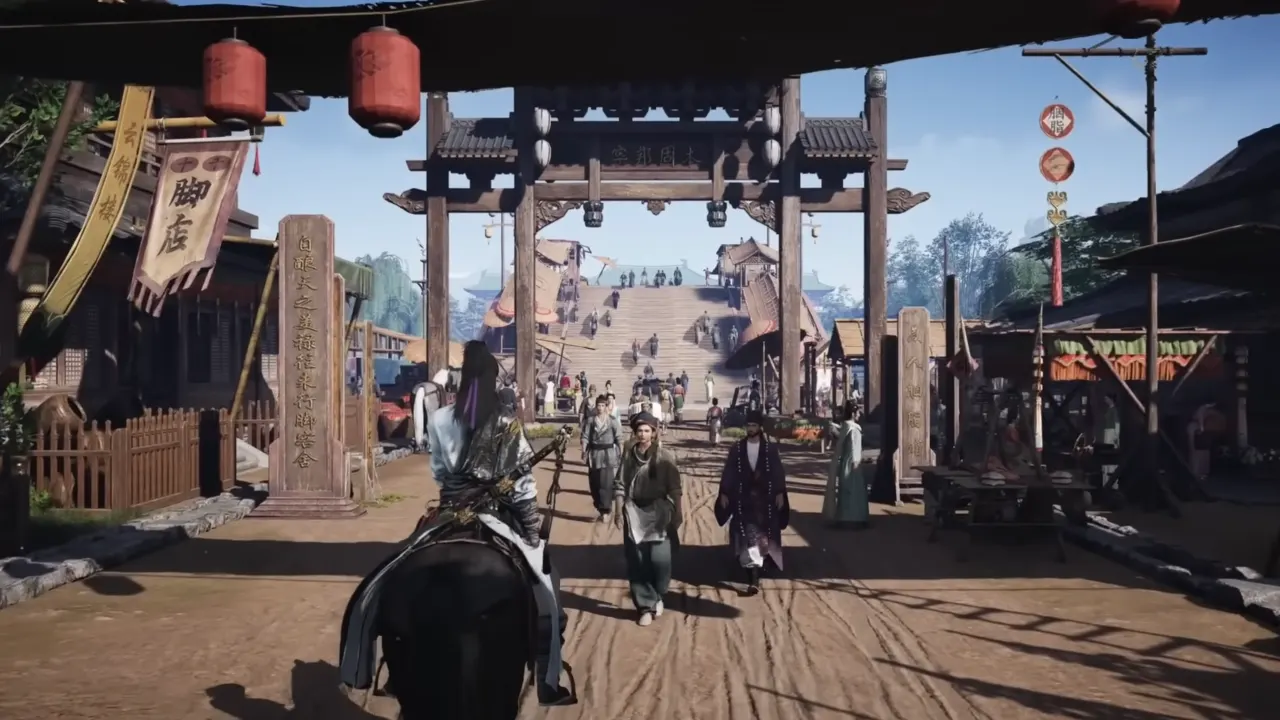
Where Winds Meet asks players to choose between ARPG and MMORPG mode almost immediately, before the game’s world has had a chance to explain itself; the decision confuses more players than it should, mostly because these acronyms carry heavy baggage from other games. In this guide, we’ll explain what ARPG and MMORPG mean on their own terms, and how NetEase has implemented these modes in Where Winds Meet.
You can swap modes whenever you want without losing your progress. The actual choice comes down to how much of the world you want accessible, whether you like to play solo or co-op, and what your preference is for combat and UI.
ARPG vs MMORPG: What’s the Difference
An ARPG (or Action Role-Playing Game) centers on a single character, real-time combat, and a story that moves at your own speed. Diablo and Path of Exile 2 are well-known action RPGs that operate on this mechanic. Controls and camera are tuned for combat above all else like aiming, dodging, reacting, and the experience holds up whether anyone else is online or not.
An MMORPG (or Massively Multiplayer Online Role-Playing Games) works the other way around. Its world persists and is shared by thousands of players at once, so the draw is mostly social, with guilds, trading, global chat, PvP zones, and group content that requires real players to fill the world. The story remains behind systems designed to keep a population logged in together, like economy, ranking, raid rotations, and the like.
Where Winds Meet declines to pick a side and lets you create a single character and switch between the ARPG and MMORPG whenever you like, which is why the mode choice at launch feels tougher than it needs to be.

ARPG Mode (Lone Wanderer) Explained
ARPG mode is the default, and that makes sense because every element that makes Where Winds Meet a wuxia RPG is in this mode. That includes the main story, open world exploration, boss fights, side quests, puzzles, and the Breakthrough system, which lets you break a level cap every ten levels after clearing three waves of enemies. None of it is accessible from MMORPG mode.
You are not stuck in a solo bubble, either. You can invite three other people to form a four-man squad for co-op, and most early- to mid-game content plays out just like it does offline.
ARPG mode uses the more action-focused control layout. You can aim reliably, don’t need to hold mouse buttons to rotate the camera, and the UI is not cluttered with MMO-style bars. However, PvP is not available in ARPG, and it’s good in a sense because only you (or you and friends) enjoy the world events at your own pace. With that said, this mode allows co-op raids, but some high-tier raids and future dungeon content are exclusive to MMORPG. If you want to complete the story or want to enjoy the full game content, you should choose ARPG mode.

MMORPG Mode (Shared Journey) Explained
MMORPG mode is the online multiplayer part of the game. It’s not a traditional MMO, so don’t expect a massive trading economy or an endless open world PvE loop on the scale of Black Desert Online or Age of Wushu. Expecting either will lead to disappointment. It’s just a shared space where you can see other players and access the social systems.
What the mode offers:
- A shared field where other players appear in real numbers, sometimes in the thousands.
- PvP, including duels and direct player-versus-player combat.
- Guilds, public events, social zones, and raids exclusive to this mode.
- Healers who can cleanse injury and illness status effects on other players.
- MMO-specific content and modes.
What it does not offer:
- Story progression of any kind — the campaign does not advance here.
- Leveling at a normal pace — grinding is noticeably slower than in ARPG mode.
- A living open world PvE loop — most enemy spawns are removed so the area functions as a hub rather than a wilderness.
The closest analogues are the hub areas in Monster Hunter World or the shared lobby in Red Dead Online, a meeting point centered on particular systems.
Camera behavior changes, too. Instead of following mouse movement, you have to hold the right mouse button to rotate the camera view, the more familiar setup for anyone who played traditional MMOs, and a minor adjustment if you already played ARPG mode.
ARPG vs MMORPG in Where Winds Meet
| ARPG Mode | MMORPG Mode | |
|---|---|---|
| Main story progress | Yes | No |
| Leveling speed | Normal | Slow |
| PvP | No | Yes |
| Co-op (up to 4 players) | Yes | Yes |
| Guilds & social hubs | Limited | Yes |
| World bosses & open PvE | Yes | Mostly stripped out |
| Exclusive raids/dungeons | Some | Some (newer content) |
| Camera controls | Mouse-follow, no hold needed | Hold right-click to rotate |
| Population per world | Small (player + party) | Up to 1,000+ players |
Can You Switch Between Modes, and Does It Cost You Anything?
To switch, open the map (M on keyboard, Start on controller) and select either the Solo or Multiplayer tab in the corner, then choose a location to teleport into. There is no cooldown or penalty attached, and players can move between modes as many times as they like within a single session. Character level, gear, and Breakthrough progress carry over between the modes without exception.
Each new session still begins in Solo/ARPG mode by default, however, so a PvP session or guild event requires switching over again after every fresh launch.
So Which One Should You Choose?
Select ARPG mode if you want the full game, story progression, proper combat action, and full world exploration. But if you have to socialize, duel players, join large raids, or hang out in shared hubs, all this is only possible in MMORPG. Almost everyone starts with ARPG mode and sticks to it since it’s where the mechanics breathe. But being able to swap whenever you want is the real strength of the system.